

Leaving a Large Brokerage Firm? What to Know Before You Move
Thinking of moving $1-5 million from a large brokerage firm? Compare fee layers, fiduciary duty, and how an in-kind account transfer works.


If you have $1 million to $5 million at Morgan Stanley, Merrill Lynch, or UBS, you have probably asked yourself at least once: "What am I really paying, and is my advisor working for me or for the firm?"
You do not have to guess. These firms publish their fees and conflicts in documents anyone can read. This guide walks you through what they say, how a fee-only fiduciary is different, and what moving your accounts actually involves.
What is the difference between a wirehouse and a fee-only fiduciary?
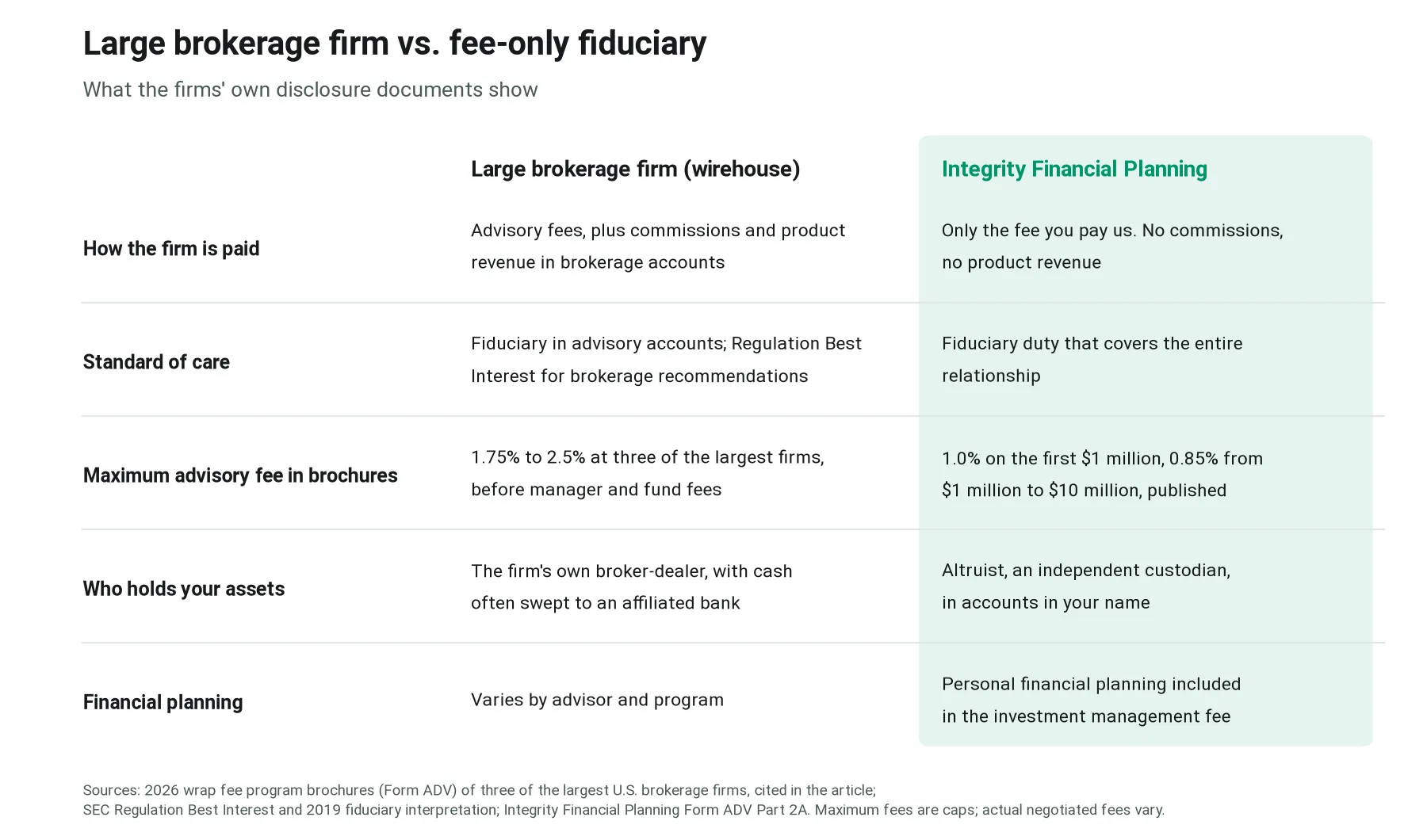
A wirehouse is a large national brokerage firm, such as Morgan Stanley, Merrill Lynch, or UBS. These firms both sell investment products and give advice. A fee-only fiduciary, like Integrity Financial Planning, only gives advice and is paid only by its clients, with no commissions or product revenue.
That difference shapes the rules your advisor follows:
- In a brokerage account, a broker's recommendations fall under Regulation Best Interest. The SEC says brokers must act in your best interest "at the time the recommendation is made" (SEC).
- A registered investment adviser owes a fiduciary duty that, in the SEC's words, "applies to the entire relationship" between the adviser and the client (SEC).
Wirehouse advisory accounts are also held to a fiduciary standard. The difference is that a wirehouse can earn money in more ways, and some of those ways create conflicts it must disclose. A fee-only firm has one source of revenue: the fee you can see on your statement.
What do Morgan Stanley, Merrill, and UBS charge?
Each firm publishes a maximum advisory fee in its wrap fee brochure (Form ADV). The rate you pay is negotiated, so it may be lower. But the advisory fee is often only the first layer.
| Firm and program | Maximum advisory fee | Charged on top |
|---|---|---|
| Morgan Stanley Select UMA | 2.0% a year | Sub-manager fees, generally 0.20% to 0.75%; a 0.035% platform fee; fund expenses |
| Merrill Lynch Investment Advisory Program | 1.75% a year | Style manager fees if you choose a manager strategy; fund expenses |
| UBS PACE, Strategic Advisor, and ACCESS | 2.5% a year | Separate account manager fees; fund expenses |
Sources: Morgan Stanley Select UMA brochure, Aug. 5, 2026; Merrill Lynch Investment Advisory Program brochure, Sept. 18, 2026; UBS wrap fee programs brochure, Mar. 31, 2026.
Two details are easy to miss:
- The fee usually applies to your cash. Morgan Stanley's brochure says cash, "including assets invested in Sweep Vehicles," is included in the fee calculation. Merrill's brochure says you are charged the program fee on all assets, "including cash and cash alternatives."
- Cash rates depend on the account type. Bank sweep rates are tiered by balance and account type, and brokerage accounts can earn far less than advisory accounts (Merrill rate sheet). If you hold cash at a large firm, ask what rate it earns today.
For more on how these layers add up near retirement, see why Houston executives move to a fee-only fiduciary.
Do fee-only fiduciaries cost less?
In many cases, and you can check the math yourself. Our fee schedule is published: 1.0% a year on the first $1 million and 0.85% from $1 million to $10 million. Our portfolios use low-cost ETFs, and an all-ETF portfolio has internal expenses of a little under 0.05% a year. There are no trading commissions to add: Altruist, our custodian, does not charge a fee to buy or sell U.S.-listed stocks and ETFs (Altruist). Small regulatory and exchange fees can apply to some transactions.
Here is a hypothetical comparison with a 1.50% all-in cost at a large brokerage firm. That is the low end of the roughly 1.5% to 2.0% that advisory, manager, platform, and fund fees often add up to. Wrap fees alone can range from 1% to 3% of assets, according to The Wall Street Journal.
| Portfolio | Hypothetical brokerage cost (1.50%) | Our fee + about 0.05% fund expenses | Difference per year |
|---|---|---|---|
| $1 million | $15,000 | $10,500 (1.05%) | about $4,500 |
| $2.5 million | $37,500 | $24,000 (0.96%) | about $13,500 |
| $5 million | $75,000 | $46,500 (0.93%) | about $28,500 |
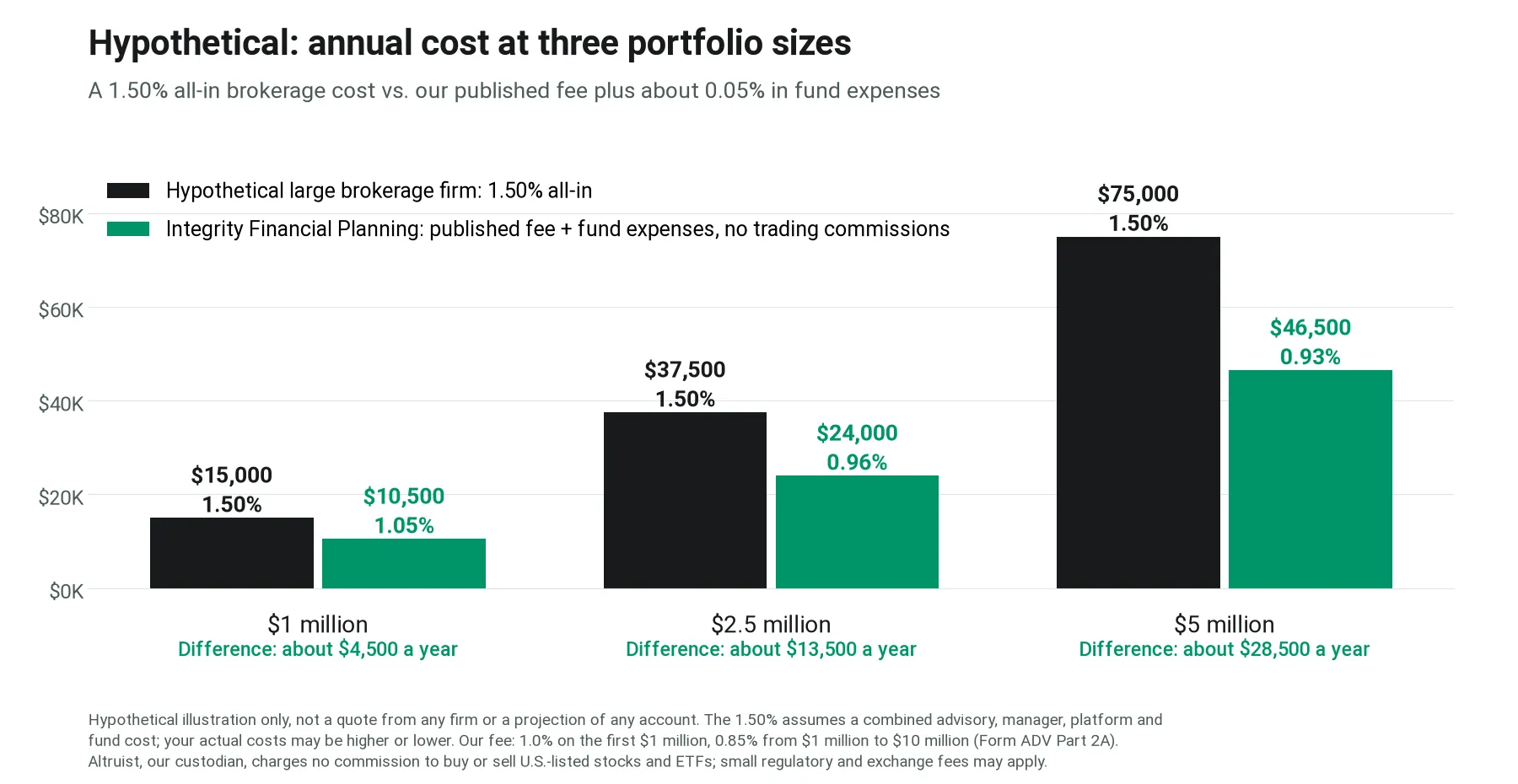
Every dollar not paid in fees stays invested and keeps compounding. Over 10 or 20 years, that gap can grow far larger than the yearly difference suggests.
Your own numbers may differ, so look at your statements. Add the advisory fee rate, any manager or platform fee, and the expense ratios of the funds you own. If the total is above about 1.0%, it is worth a second look.
How can you judge the quality of advice?
That depends on the advisor, not the logo. Instead of taking anyone's word for it, look for things you can verify:
- Experience on both sides. Todd Smurl, CFA, spent 30 years managing portfolios, including roles at Goldman Sachs Personal Financial Management and Bank of America's Private Bank, before founding the firm. Ryan Firth is a CPA/PFS and CFP® professional. You can read their backgrounds on the Todd Smurl and Ryan Firth pages.
- No products to sell. We earn no commissions, sales loads, or revenue sharing.
- Planning is included. Personal financial planning, including retirement income, Social Security, and estate coordination, is included in the investment management fee. See financial planning. For clients with assets under management under $500,000, the Advisor reserves the right to charge an hourly fee for financial planning.
- Tax-aware investing. Our Personal Index Portfolios hold individual stocks in place of a large-cap fund, which can reduce fund-level capital gains distributions and makes tax-loss harvesting possible in taxable accounts. Learn why direct indexes can be more tax-efficient than ETFs.
Active tax management is optional and applies to taxable accounts only. Altruist, our custodian, charges up to 0.10% per year on the enrolled assets for its tax-management tool, separate from our advisory fee; Integrity Financial Planning receives no part of it.
If you own a business, note that tax planning for business owners is a separate service. It is not included in the investment management fee. Each project is a custom engagement, priced and agreed separately before work starts. The project fee may be reduced by investment management fees you pay us.
How do I move my accounts without selling everything?
Most accounts move "in kind," which means your holdings transfer as they are. Nothing is sold, so the move itself does not create a tax bill.
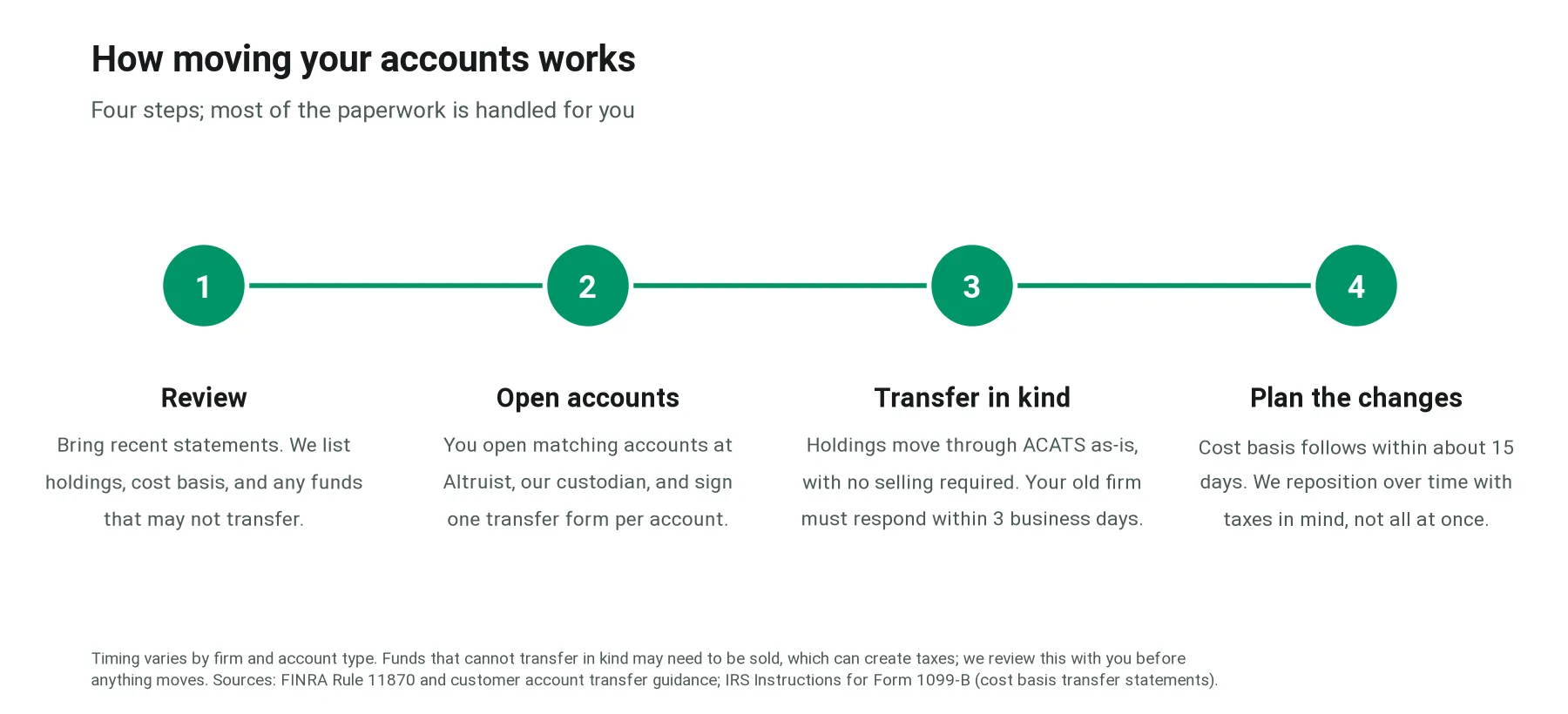
- Review. Bring recent statements. We list your holdings and cost basis and flag anything that may not transfer.
- Open accounts. You open matching accounts at Altruist, our independent custodian, and sign a transfer form for each account.
- Transfer. The request goes through ACATS, the industry's automated transfer system. Under FINRA Rule 11870, your current firm must validate or respond to the request within three business days. FINRA notes that customers "have the right to move their accounts freely."
- Plan the changes. Your old firm must send cost basis information within 15 days of settlement (IRS). We then reposition over time, weighing taxes, rather than selling everything at once.
Watch for proprietary funds. Some firms' in-house funds and certain annuities or alternative investments cannot be held at other firms. These may need to be sold, which can create a taxable gain. We review each one with you, and the timing of any sale, before anything moves.
Questions to ask your current advisor
Whether you stay or go, these questions show you what you are paying and who your advisor works for:
- What is my total annual cost, including the advisory fee, manager fees, platform fees, and fund expenses, in dollars?
- Is my account a brokerage account, an advisory account, or both?
- Is my cash included in the advisory fee, and what rate does it earn?
- Do you or the firm earn anything from the funds or products in my account?
- Do any of my holdings fail to transfer to another firm?
- Who prepares my financial plan, and how often is it updated?
If an answer is vague, that is useful information too. Our article on mistakes to avoid when choosing a financial planner covers more questions to ask.
Ready to compare?
Bring your latest statements to a free introductory meeting. We will show you, in dollars, what you are paying today and what you would pay with us. No pressure and no obligation.
Schedule an introductory meeting with Todd Smurl, CFA, or Ryan Firth, CPA/PFS, CFP®. We work with retirees and pre-retirees in Houston and across the country.
This article is for educational purposes only and is not individualized investment, tax, or legal advice. Fee information for other firms comes from their published disclosure brochures as of the dates shown. It reflects maximum rates, not what any client pays, and may change. The cost comparison is hypothetical: it assumes a 1.50% all-in cost at a brokerage firm and our published advisory fee plus about 0.05% in fund expenses, and is not a projection of any account. Actual fees, returns, and tax results vary and are not guaranteed. Transferring accounts can involve fees charged by your current firm, and selling non-transferable holdings can create taxes. Full fee terms are in our Form ADV Part 2A. Morgan Stanley, Merrill Lynch, and UBS are trademarks of their respective owners and are not affiliated with Integrity Financial Planning.
Frequently asked questions
Is a wirehouse advisor a fiduciary?
Sometimes. Large firms like Morgan Stanley, Merrill Lynch, and UBS are usually both brokers and investment advisers. In advisory accounts they act as fiduciaries. In brokerage accounts, recommendations fall under Regulation Best Interest, which applies at the time a recommendation is made. A fee-only fiduciary like Integrity Financial Planning has no brokerage business, so the fiduciary duty covers the whole relationship.
How much does a wirehouse advisory account cost?
It depends on what you negotiated, but the firms' brochures set the ceilings: 2.0% at Morgan Stanley Select UMA, 1.75% for the Merrill Lynch Investment Advisory Program, and 2.5% for UBS wrap fee programs. Separate manager fees (often 0.20% to 0.75%), platform fees, and fund expenses can be added. Your quarterly statement and the firm's Form ADV wrap fee brochure show your actual rate.
What does Integrity Financial Planning charge on $1 million to $5 million?
Our fee is 1.0% per year on the first $1 million and 0.85% from $1 million to $10 million. That is $10,000 a year on $1 million, about $22,750 (0.91%) on $2.5 million, and about $44,000 (0.88%) on $5 million. Altruist, our custodian, charges no commission to buy or sell U.S.-listed stocks and ETFs. Personal financial planning is included in the investment management fee. See our fees.
Will I owe taxes if I move my account from Morgan Stanley, Merrill, or UBS?
Not from the transfer itself. Moving holdings in kind through ACATS is not a sale. Taxes can arise if a holding cannot transfer, such as some proprietary funds, and has to be sold, or when positions are changed after the move. We review cost basis and any non-transferable holdings with you before anything moves.
How long does it take to transfer an account?
Under FINRA Rule 11870, your current firm must validate or respond to an ACATS transfer request within three business days. Total timing varies by account type and the assets being moved. Cost basis information must follow within 15 days of settlement.
Do I have to tell my current advisor I am leaving?
No. The transfer starts with a form you sign at the new custodian, and your current firm receives the request through ACATS. Many people still choose to call their advisor as a courtesy.
Get our insights by email
Occasional notes on planning, portfolios, and taxes. Unsubscribe anytime.
This article is for general educational purposes and is not individualized tax, legal, or investment advice. Tax laws change; confirm how current rules apply to your situation before acting. See our disclosures.